

Ever looked at a calendar and wondered how many weeks in a year there actually are? You’re not alone. It sounds like a basic question, but once leap years, calendars, and leftover days come into play, it gets a little more interesting than you might expect.
In this guide, we’ll break it all down in a way that’s easy to understand. You’ll learn how many weeks are in a year, how leap years affect the count, and exactly how many weeks in a year 2024 and how many weeks in a year 2025—no math headache required.
How Many Weeks in a Year? The Short Answer
Most years have:
-
52 weeks
-
Plus 1 extra day
That’s because a standard year has 365 days, and when you divide 365 by 7, you get:
52 weeks + 1 day
So while we commonly say a year has 52 weeks, it’s technically 52 weeks and 1 day.
Why a Year Isn’t Exactly 52 Weeks
A week has 7 days, but a year doesn’t divide evenly into weeks.
Here’s the math:
-
7 days × 52 weeks = 364 days
-
Standard year = 365 days
-
Leap year = 366 days
That leftover day (or two in leap years) is why calendars shift slightly each year.
How Many Weeks in a Leap Year?
A leap year has 366 days, which equals:
52 weeks + 2 days
Leap years exist to keep our calendar aligned with Earth’s orbit around the sun. Without them, seasons would slowly drift out of sync.
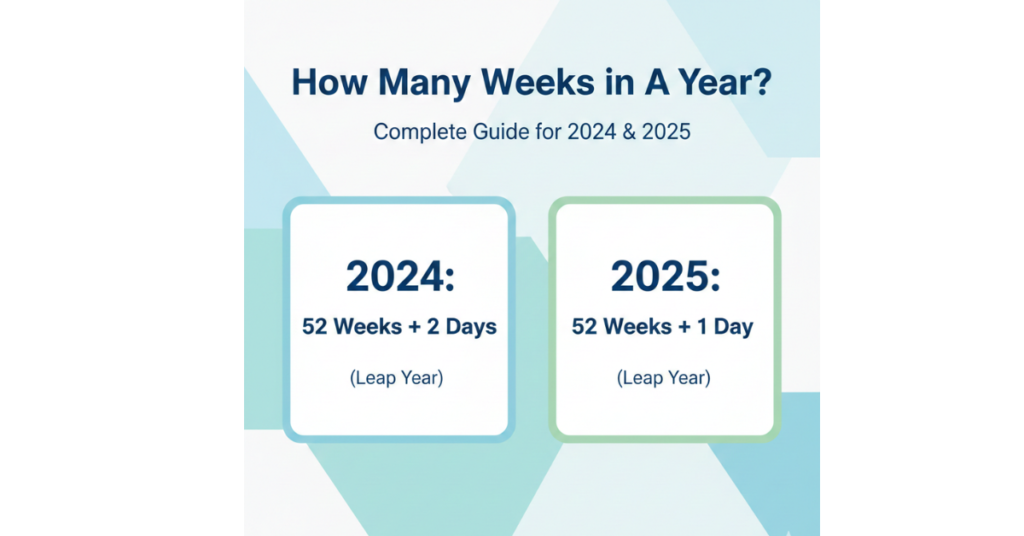
2024?
2024 is a leap year, which means:
-
366 days
-
52 weeks and 2 extra day
So the correct answer is:
There are 52 weeks in the year 2024
Those two extra days are why 2024’s calendar looks slightly different from 2023.
2025?
2025 is not a leap year, so it follows the standard structure:
-
365 days
-
52 weeks and 1 extra day
That means:
There are 52 weeks in the year 2025
Can a Year Ever Have 53 Weeks?
Technically, yes—but it depends on how weeks are counted.
In some systems:
-
A year can appear to have 53 calendar week
-
This usually happens when:
-
The year starts or ends late in the week
-
ISO week numbering is used (common in business and accounting)
-
However, most people and calendars still consider the year as having 52 weeks.
Weeks vs Days: Why This Matters
Understanding how many week are in a year is helpful for:
-
Salary and payroll calculations
-
Fitness and habit tracking
-
School and academic planning
-
Project timelines
-
Content scheduling and publishing
Even one extra day can impact long‑term planning.
Quick Breakdown: Weeks in a Year
| Year Type | Days | Weeks |
| Standard Year | 365 | 52 weeks + 1 day |
| Leap Year | 366 | 52 weeks + 2 days |
| 2024 | 366 | 52 weeks |
| 2025 | 365 | 52 weeks |
FAQs
How many weeks are in a year exactly?
A year has 52 weeks, plus 1 extra day (or 2 days in a leap year).
How many week in a year 2024?
2024 is a leap year, so it has 52 weeks and 2 extra days.
How many week in a year 2025?
2025 is a standard year with 52 weeks and 1 extra day.
Is there ever a year with 53 weeks?
In some calendar systems like ISO week numbering, yes—but most years are still counted as 52 weeks.
Why don’t calendars show partial week?
Calendars display full weeks for simplicity, even though years don’t divide perfectly into seven-day blocks.
Conclusion: The Takeaway
So, how many weeks in a year? The simple answer is 52 weeks, but the full picture includes extra days that shift calendars forward each year. Whether you’re planning ahead for 2024, mapping out 2025, or just satisfying curiosity, understanding how weeks work makes scheduling a whole lot easier.
If you’re interested in time‑related topics, calendars, or productivity planning, consider exploring related guides on leap years, months in a year, or how calendars are structured worldwide.